
|
How Old Do You Have To Be To Open a thinkorswim Account?
|
thinkorswim Age Requirement
You need to be at least 18 years old to open your own individual Charles Schwab brokerage account in the U.S. However, teens ages 13 to 17 can use thinkorswim through a Schwab Teen Investor™ account, which is a joint brokerage account opened together with a parent or guardian. Continue reading to learn how these accounts work.
Age of Majority
The age of majority is the point at which the law considers a person an adult. In most U.S. states, this is age 18, although certain states use different ages for some legal purposes. At Schwab, someone who turns 18 becomes eligible to open an individual brokerage account independently.
Brokerage accounts can have different eligibility requirements, giving minors several ways to hold investments before reaching adulthood. Schwab provides a Teen Investor account for customers ages 13 to 17 along with custodial accounts designed for younger investors.
Free thinkorswim Account
thinkorswim On Schwab
Custodial Accounts
There are two common custodial brokerage account registrations in the United States:
the Uniform Transfers to Minors Act (UTMA) account and the Uniform Gifts to Minors Act (UGMA) account. The two
work in similar ways and generally receive similar tax treatment. UGMA accounts typically can hold cash, securities, and certain insurance products, while UTMA accounts can accept a wider variety of property, including real estate. Most states use the UTMA, though some still use the UGMA.
A custodial account involves two people: an adult custodian who manages the account and a minor who is the beneficiary. This arrangement allows minors to own brokerage assets. The minor does not control or access a Schwab custodial account until the custodianship terminates under applicable state law.
The adult serving as custodian does not have to be the person who contributes assets to the account. Parents, grandparents, other relatives, friends, and additional contributors can make deposits, and the custodian can add money as well.
In each case, the assets belong to the minor as soon as they are contributed. The custodian is responsible for managing those assets for the minor’s benefit. Once the custodianship terminates at the age required by state law, control of the account transfers to the beneficiary.
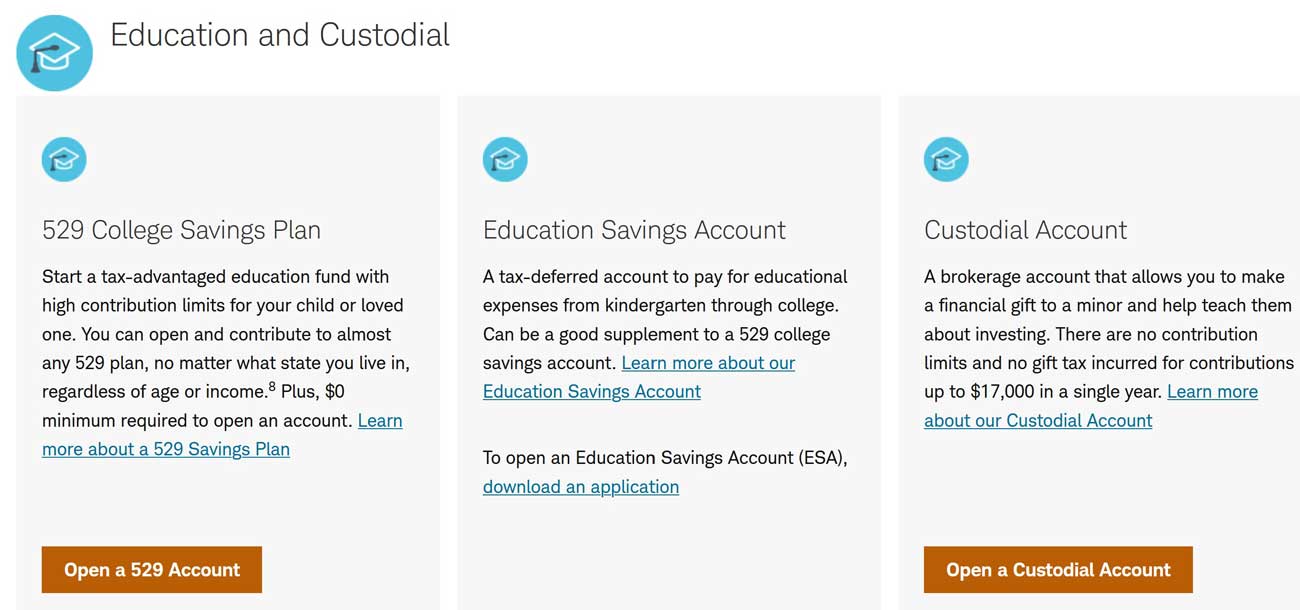
If someone later changes their mind and wants to reclaim money or investments contributed before the child reaches adulthood, that generally isn’t permitted. Assets contributed to a custodial account are irrevocable gifts to the minor.
With custodial accounts, the custodianship commonly ends at age 18 or 21, although the termination age can reach 25 under the laws of certain states. At that point, control over the account is transferred to the beneficiary.
While the custodianship remains in effect, assets in the account can be spent on expenses benefiting the minor and are not restricted only to educational costs. After the beneficiary assumes control, the money can generally be used for any purpose.
Where to Open a Custodial Account
Charles Schwab is likely the most popular choice for a brokerage custodial account. There are no account opening or maintenance fees,
online commissions on listed stocks and ETFs are $0, and you receive many of the advantages that come with investing through one of
the world's largest brokerage firms.
Open thinkorswim Account
Coverdell Education Savings Plan
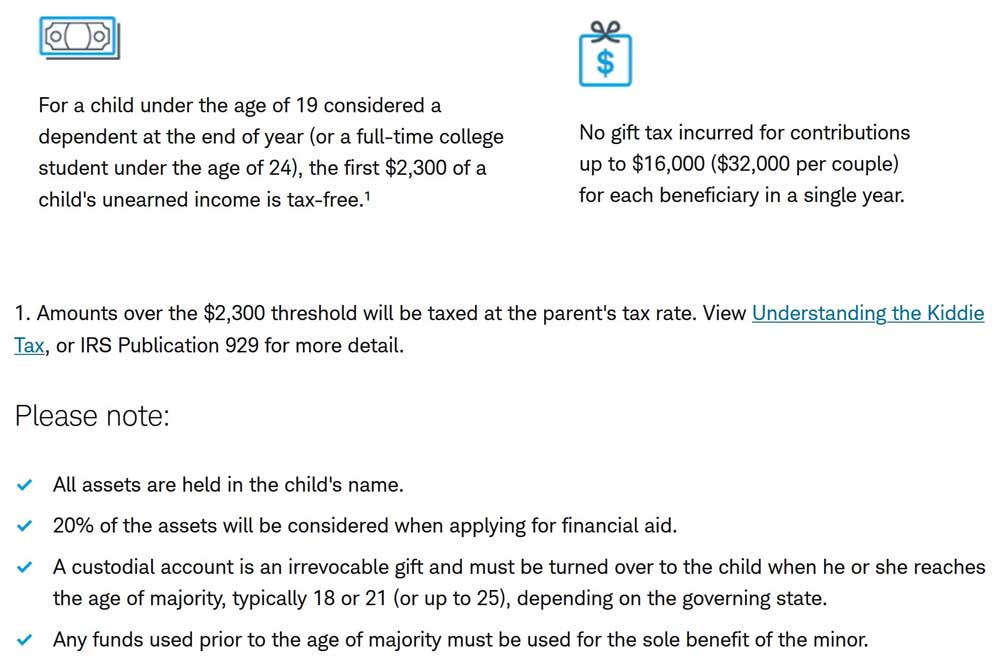
A Coverdell Education Savings Account is another possibility. Assets held in a Coverdell account can pay for qualified education expenses from kindergarten through college. When the account is opened, the beneficiary generally needs to be younger than 18, with an exception available for special-needs beneficiaries.
Parents and grandparents are common Coverdell contributors, but organizations including corporations and trusts are permitted to contribute as well. Organizations are not subject to income limits for these contributions, while individuals face income-based eligibility limits. Total contributions from all sources are limited to $2,000 per beneficiary per year.
529 Plans
Another choice is a 529 plan, which is a widely used account for education savings. Unlike a Coverdell account, a 529 plan does not require the beneficiary to be a minor. An account owner controls the assets and designates the beneficiary. Qualified distributions can cover college and graduate-school costs as well as K-12 education expenses, eligible apprenticeship programs, certain student-loan repayments, and other qualified educational expenses. Compared with an ordinary brokerage account, a 529 plan provides several tax advantages.
Opening a 529 plan might be a bit more difficult than the other two account types already mentioned, as many online brokerage firms don’t offer them.
Minor IRA
The final account covered here is an IRA for a minor. It operates much like another Individual Retirement Account, except an adult custodian controls the account for the child until the custodianship ends according to applicable state law. There is no minimum age to open a Schwab Custodial IRA.
The primary requirement for this type of IRA is that the minor must have earned income to make contributions. Regular IRAs are subject to the same earned-income requirement.
Written by Alex Bost
Updated on 8/26/2026.
|